-
 January 15, 2026 11:44am
Is the story starting over now?
After the collapse of the Warsaw Pact and the end of the East West conflict, Francis Fukuyama proclaimed “The End of History.” Liberal democracy was seen as the final form of human government.
Today, unfortunately, we have to soberly admit that we were on the wrong path. After the most recent developments in Venezuela, it has once again become clear that the entire geopolitical structure seems to be reorganizing itself. And this should interest many business leaders, at least those who have so far done good business in exports, especially with the United States. At the moment we are witnessing that two power blocs in particular are openly displaying imperial ambitions: the United States and Russia.
Trumpist demonstrations of power are indications that the decades long partnership with the United States must at least be questioned. Not only the loss of Russian business due to sanctions and the concretely threatening situation in the East, but now also a new front in the West require new strategic thinking in Germany’s sandwich position. Companies need raw material supplies that are not dependent on Russia, China, or the United States.
Sales markets must be reorganized and reprioritized. The United States is currently not a reliable partner, and China is currently creating more dependencies than synergies. As Europe now has to move closer together, new shared tasks naturally emerge that will ensure capacity utilization and sales within the European Union. This certainly includes the defense industry, but it is also about the supply of other products and semi finished goods.
Electric mobility and climate protection could also become important innovation and growth drivers in the coming years. Appropriate political course setting is helpful and within the realm of what is possible. Insourcing is fundamentally a path to more value creation in Europe. Although this will not be achievable without a loss of margins, business continuity has priority in the era of polycrisis. Not to be forgotten is the entire industry that deals with building resilience capability.
The population will be willing to invest more money in preparedness in order to be ready for a temporary crisis situation in an emergency. The recent power outage in southwest Berlin clearly shows the vulnerability of our fragile system. Seemingly insignificant disruptions have enormous effects. Just imagine something like this happening in parallel in several places. That would temporarily overwhelm the state, to the detriment of the population and businesses.
My final plea is therefore to develop crisis proof business models and to invest more in preparedness and vigilance. Because ignorance and resilience amnesia cost significantly more and can be fatal. We are living in times of great uncertainty and political upheaval, the effects of which we cannot yet foresee. But we are still behaving passively and hoping for better times or that the storm will pass us by. But it will not, because as with the weather there are constellations that create a tornado. We just do not know exactly where it will carve its path.
Share this article:


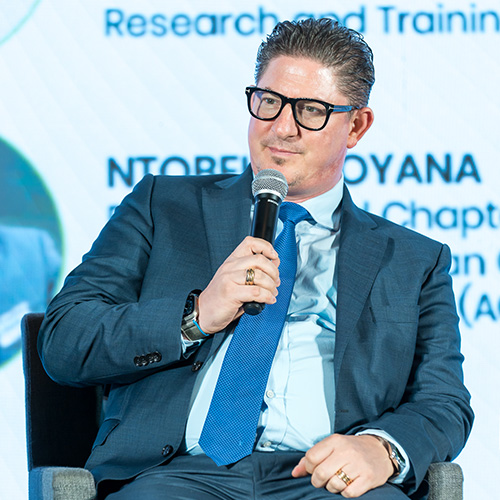
Boris van Thiel
Member of the Executive Board, LMBG GmbH
Boris van Thiel is a geographer and entrepreneur with two decades of experience living and working in the Gulf States. He currently serves as Co-Managing Director at LMBG Logistics and Management Consulting GmbH in Berlin. As the founder and driving force behind Boardroom Geopolitics, Boris explores how geography shapes global business strategy. His work delves into the connection between leadership and the geopolitical challenges that today’s executives and decision-makers must navigate. He can be reached at borisvanthiel@boardroomgeopolitics.de